Adapted from an article that appeared in Home Power Magazine.

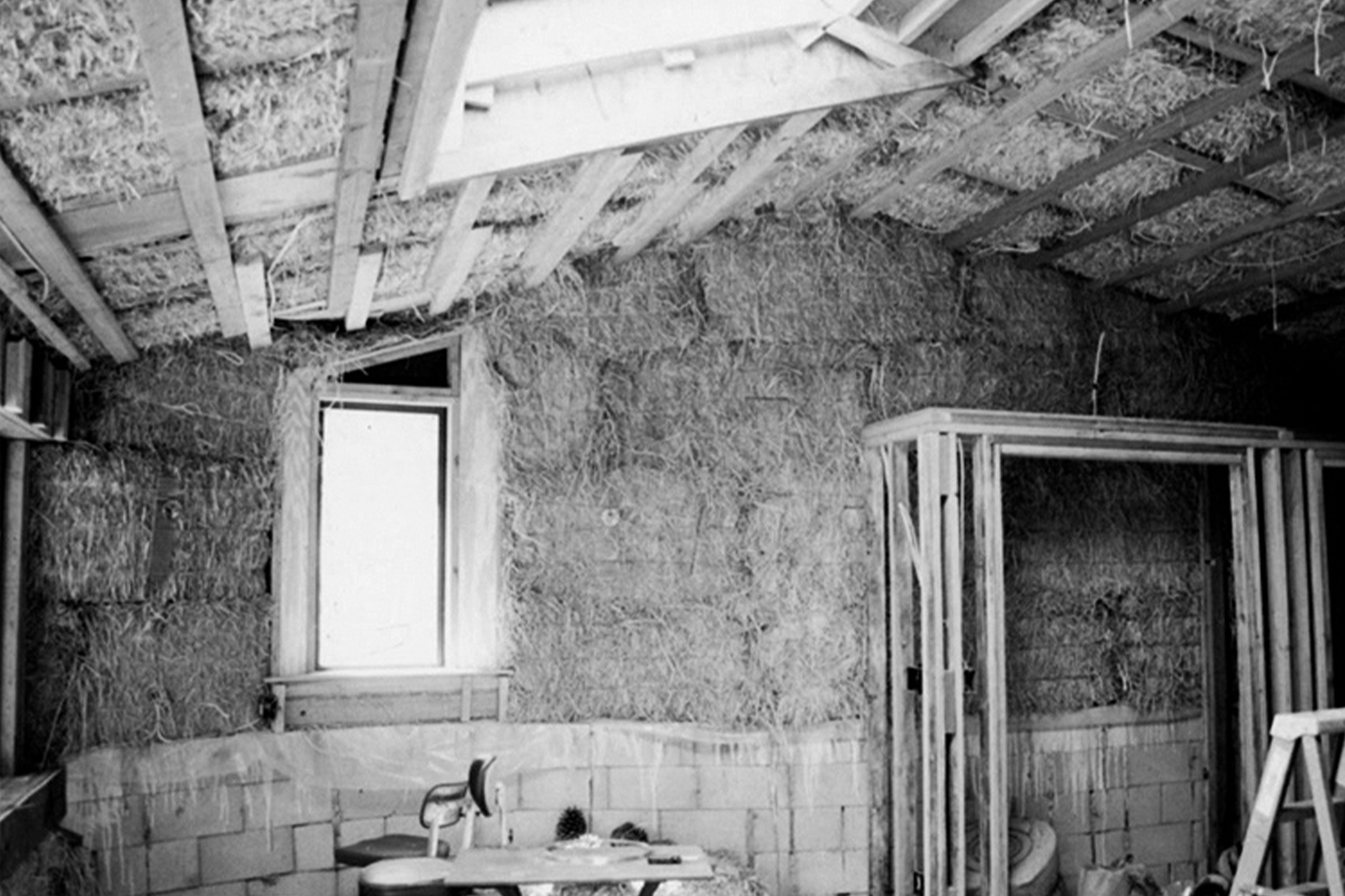
Straw-bale cottage during construction.
Like many other architectural firms in California, San Luis Obispo Sustainability Group architects had been designing building that utilized passive solar for many years. Like many other architectural firms around the country, and around the world, in recent years we found ourselves shifting our design work to “sustainability,” an extension of passive solar design concepts.
The definition of sustainability we use in our work is to use resources that meet our needs but do not compromise the ability of future generations to meet their needs. As our firm and the work we do evolved, our practice has evolved to encompass broader issues including life cycle impacts of materials, miniaturization of infrastructure, health issues in buildings, permaculture and landscape regeneration.
By 1994, we had developed a comfortable working environment, consisting of a mix-used passive solar complex that included an office, shops and a residence on an old trout farm adjacent to the Los Padres National Forest, 12 minutes north of the city of San Luis Obispo. Little did we imagine that we would endure the trauma of losing nearly everything we owned or that this tragedy would afford an opportunity to redevelop our complex based on our new knowledge of sustainability. In August 1994, the 41 Wild Fire that burned 40,000 acres/16,200 hectares in our area destroyed our entire complex, and forced us into applying these broader principles of sustainable design for ourselves. Once we got over the initial shock of losing an extensive library, slide collection, office and home, it became more and more obvious what an opportunity our natural fire-oriented local ecology offered us – we could start from scratch and build sustainably, without the problem associated with retrofitting existing structures.
One of the first things we realized was that the fire had left us with a large inventory of building material. (We had several strawbale benches on the site before the fire. They turned out to be more fire resistant than most of the stucco-, tile- and metal-clad buildings in the canyon.) It had killed most of the mature trees (except for 2/4 of the fire-adapted oaks), and these trees were now available to use as lumber. We would never have dared touch them while they were alive. In addition, the massive opening-up of the landscape afforded by the fire allowed us to examine our aging infrastructure. We realized it could be redone in a much more sustainable way. Landscape regeneration became an everyday reality, not some theoretical subject. We suddenly could do things that we had only talked about, but never had the time to do – like getting off the electrical grid.

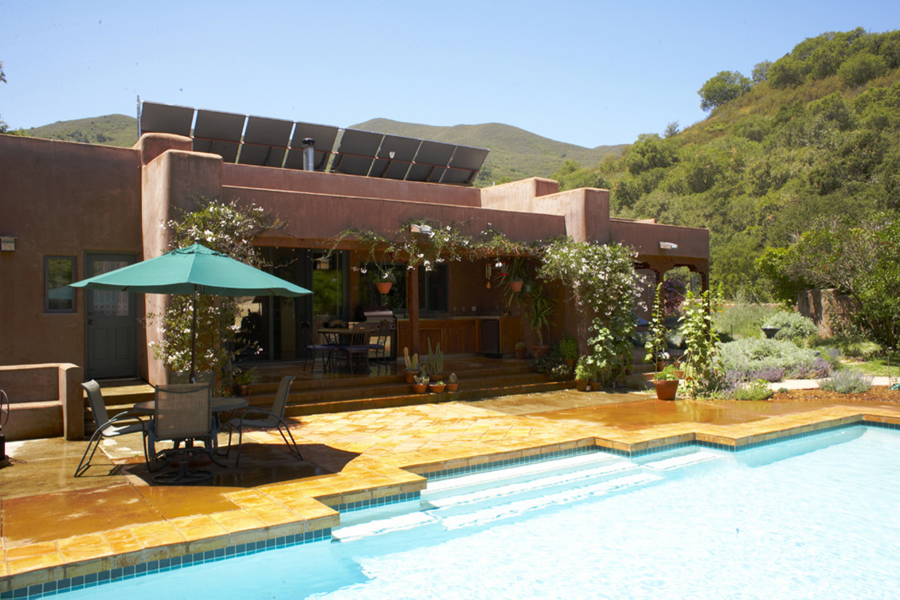
Completed straw-bale cottage.
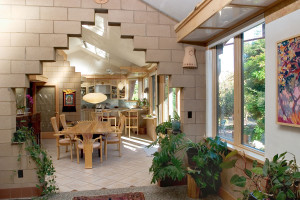 The next step was construction of the studio and office, completed at the end of March 1995. Because of the function of this building, we placed great emphasis on natural lighting in addition to the passive solar design. The studio/office is also off-grid, powered by photovoltaic (PV) panels over the library/research area, with a Pelton wheel on the adjacent creek for use as backup in the winter when the water is high. (Two streams fed by the nearby mountain range flow through the property.) The studio/office is heavy timber-frame construction with straw-bale infill.
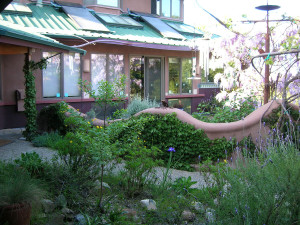 One of the unexpected joys of this whole ordeal has been to experience the rapid regeneration of the landscape following the fire. Fire is such an integral part of the native California landscape that everything is set up for it. The first spring was dominated by delicate fire poppies, which only appear in newly burned areas. In this case the seeds had been waiting 60 years for their chance – it had been that long since this area last burned. The next year was dominated by morning glories, which spread all over the armature of the burned branches of earlier plants. The third year was the year of low herbal plants – sages, bush poppies, soap roots and others. In the fourth year, we found the Ceonothus (wild lilac) dominating. The regeneration of oak and cypress trees then began to be much more noticeable.